
Our Infrastructure
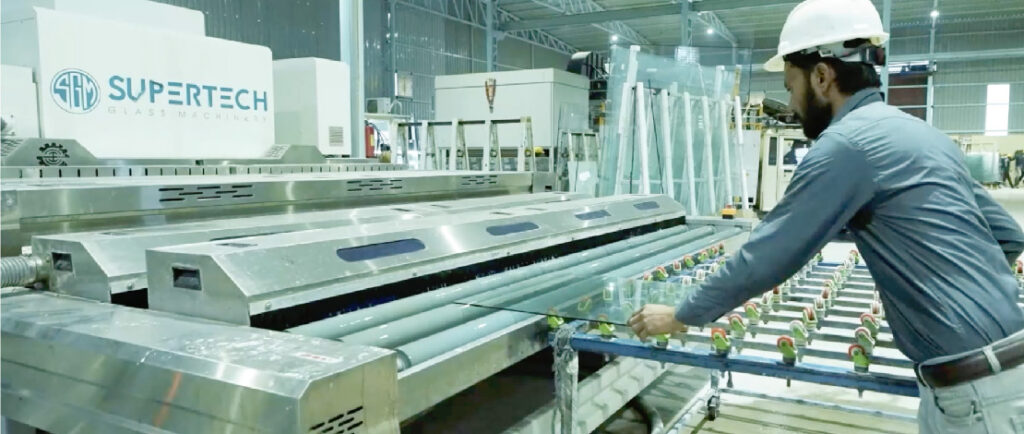
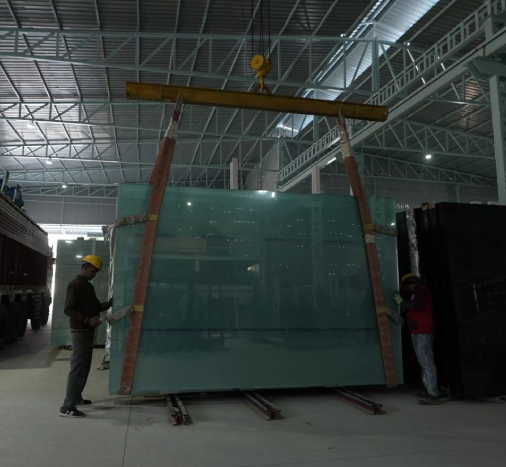
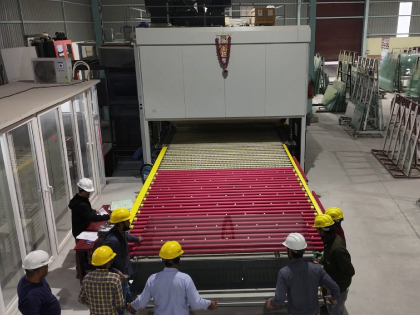
Located in Kala Amb, Himachal Pradesh, our state-of-the-art manufacturing facility is equipped with cutting-edge machines sourced globally. Operated by skilled specialists, this advanced infrastructure ensures precision and exceptional quality in every product. With a focus on continuous innovation and robust R&D, our design department is capable of handling diverse glass processing requirements.
Our Equipment's
- Cutting
- Polishing
- Drilling
- Washing
- Painting
- Tempering
- Lamination
- Bending
- Lay-up
- Vacuuming & Pressing
- Autoclave
- Insulating
- Spacer Assembly
- Insulated Glass Assembly
Our Equipment's
Cutting
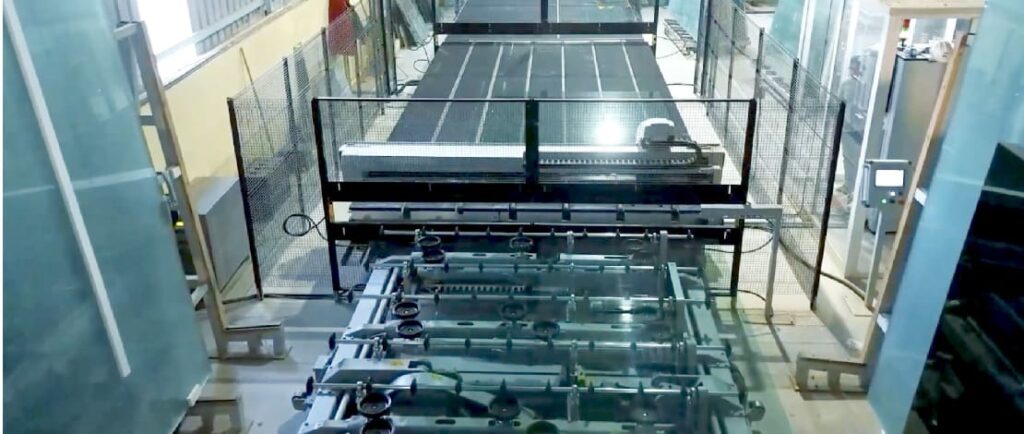
The glass manufacturing process begins by stacking float glass at the cutting line with the help of EOT crane, then our two fully automatic cutting and break lines, equipped with auto loaders cut the glass as per the desired designs. These machines can cut glass from 3-19mm thickness, with 0.5mm precision using AutoCAD and DXF files.
- (CMS 2436, Turkey): Max size: 2440 x 3660mm, productivity: 800 sqm in 8 hours.
- (Intermac 3361, Germany): Max size: 3300 x 6100mm, productivity: 2000 sqm in 8 hours.
Polishing
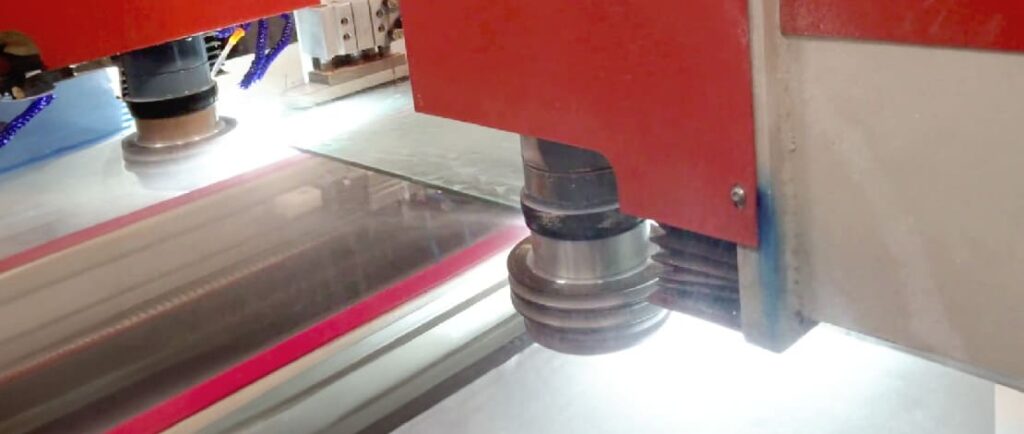
After cutting, the sharp edges of glass need to be polished giving smooth and refined edges to avoid injuries. Our polishing machines ensure easy handling and high productivity.
- Symmetric Shapes (square and rectangle): Handled by a double edger line, which can polish glass of 3-25mm thickness at a speed of 20 meters per minute. Glass sizes range from 300 x 300mm to 5000 x 5000mm. The double edger line is equipped with edge deletion facility to process triple coated glass also.
- * Asymmetric Shapes (irregular): Processed with pneumatic polishing machines, capable of polishing 3-19mm thick glass at a speed of 5 meters per minute, for sizes ranging from 300 x 300mm to 1500 x 1500mm.
Drilling
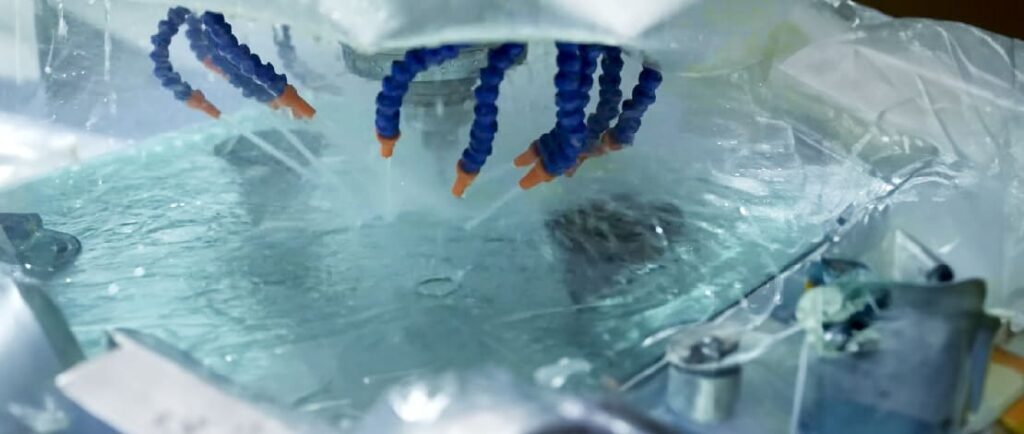
To ensure functionality holes and cutouts of various shapes are to be drilled using ultra high pressure stream of water carrying abrasive grit at the CNC waterjet and drilling machines, ensuring accuracy and precision to avoid chipping.
- We 5 drilling machines can perform up to 4800 drills in 8 hours, handling diameters ranging from 5-100mm.
- Our CNC waterjet is equipped with 6 heads for different functions ranging from drilling, milling and polishing. It can process a maximum glass size of 1530 x 2440mm.
Washing
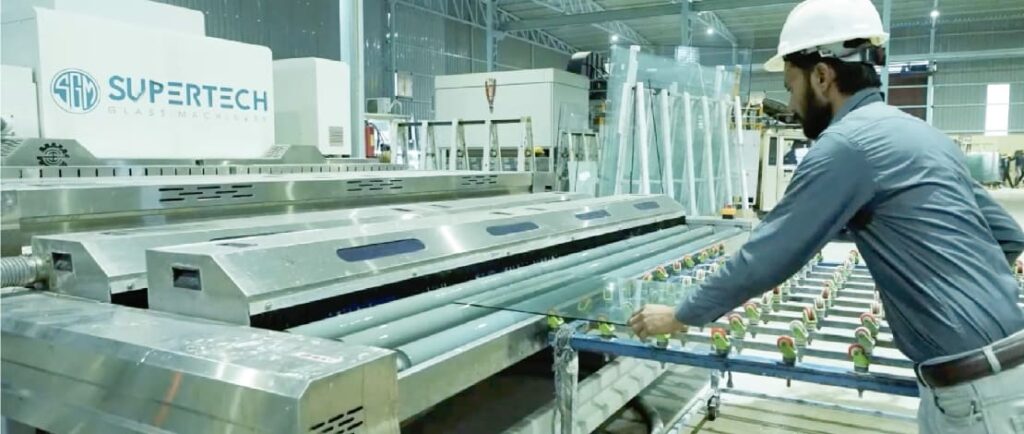
The glass undergoes a thorough washing process to remove all dirt, burr, sludges and other surface contaminants.
Our machine has three pairs of brushes ((160mm) with SS304 shaft. (Wash LOW-E glass, ordinary coated and solar coated glass without any scratch on surface).
We have 3 washing machines which can wash glass of size upto 3000 x 5000 mm and prepare it for the further stages of production.
Painting
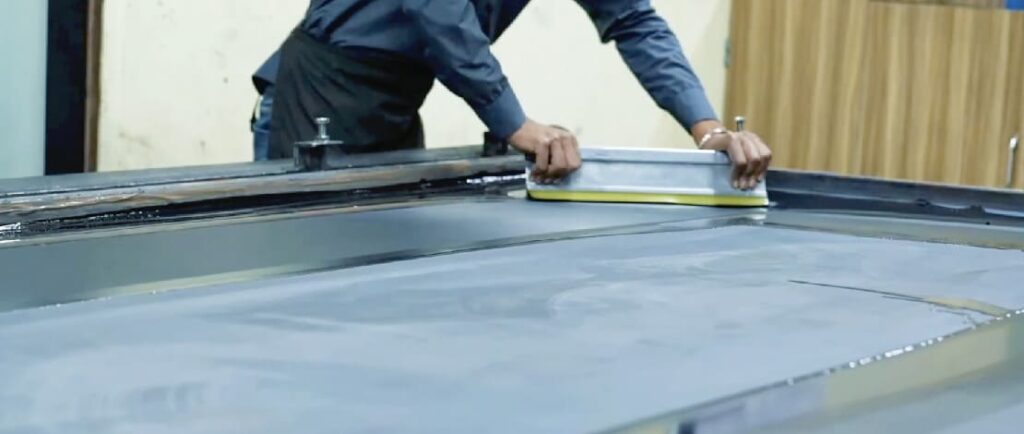
Using silk screens, ceramic paint made using glass flux and ceramic pigment is applied to create patterns or borders on glass. The application of paint is done to provide aesthetic benefits like patterns for modern buildings and functional benefits like rear defogger windshields with the help of a conductive silver paint, black borders for silicone pasted glass.
Once the Glass is painted it is heat treated so that the frits of ceramic paint melt and bond with the glass pane.
Tempering
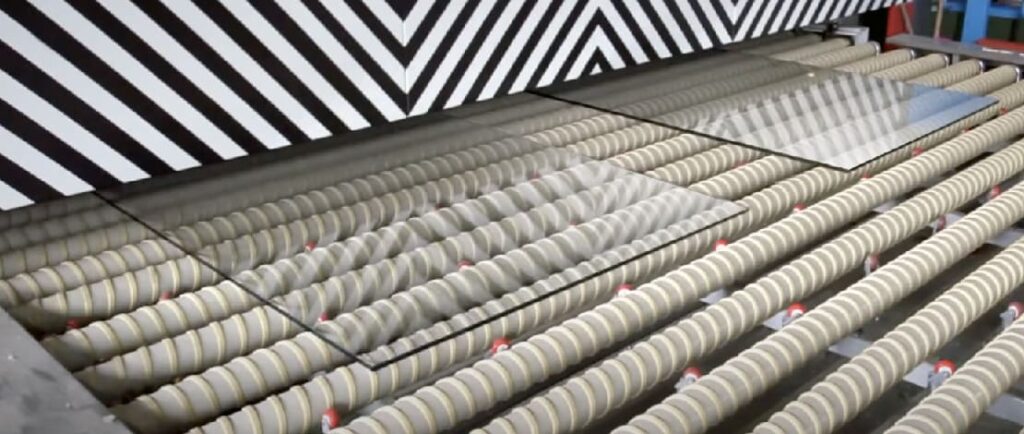
In the tempering furnace the glass oscillates back and forth on ceramic rollers until it reaches approximately 620°C. Progressing from the furnace, the glass moves into the quench where it is rapidly cooled by blasting both sides with air. This ‘snap cooling’ or quenching induces compressive stresses to the glass surface while the centre remains in tension. Although the physical characteristics remain unchanged, the additional stresses created within the glass increases its strength by 4 – 5 times that of annealed glass of equal thickness and ensures it shatters into small, safe fragments.
- Flat Glass: Thickness: 3.2-19mm, size: 175 x 175mm to 3000 x 5000mm, capacity: 15 million sqm annually.
- Single Curvature Bend Glass: Thickness: 3.2-19mm, size: 175 x 175mm to 3000 x 1600mm, capacity: 5.5 million sqm annually.
- Multiple Curvature Bend Glass: Thickness: 4-19mm, size: 400 x 400mm to 1300 x 1900mm, capacity: 2.5 million sqm annually.
Heat strengthening is a process similar to that of tempering, however in this instance the glass is quenched at a slower rate. The result is lower compressive stress, increasing the strength to only twice that of annealed glass of equal thickness.
Lamination
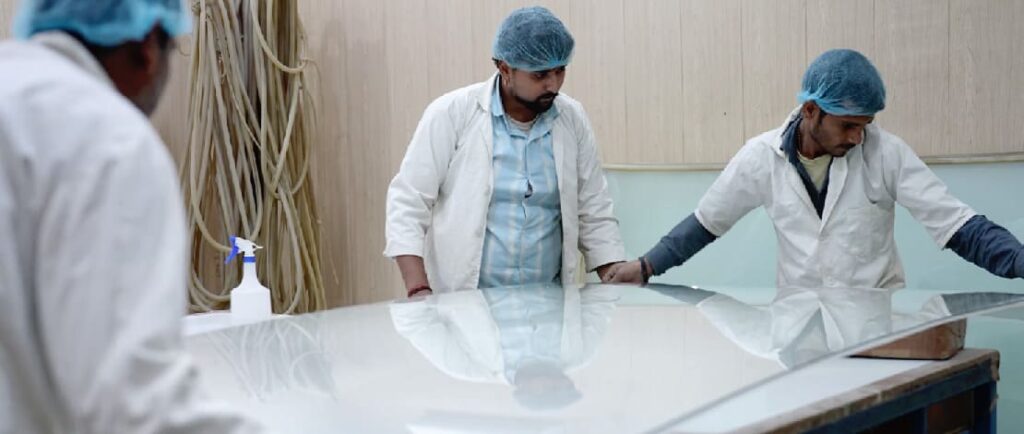
A laminated glass is a shatter proof glass that does not break but cracks when force is applied primarily due to the presence of a plastic film along with a combination of glass. Bulletproof glass is also a special type of laminated glass.
Bending
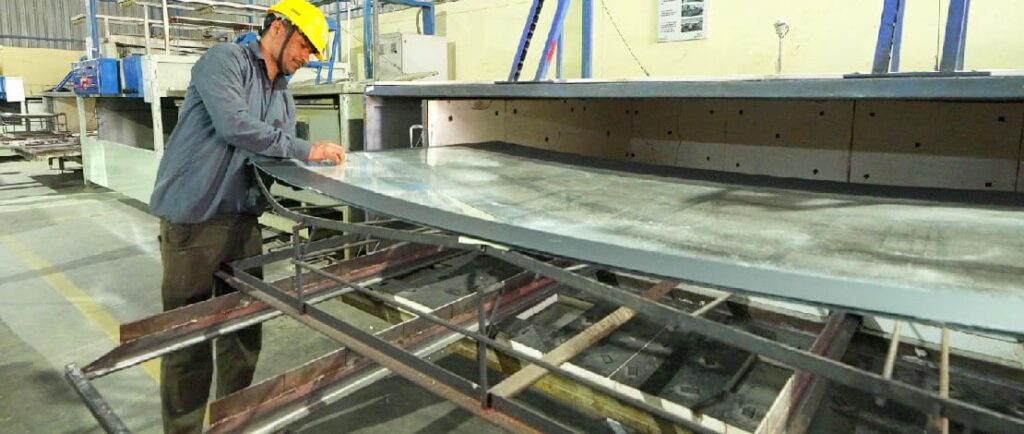
Glass is bent as per the desired shape by heating it to 600°C and then slowly cooling it down. We have 7 bending furnaces that can bend up to 85 large windshields or 350 small windshields per day, with thicknesses ranging from 4.76mm to 100mm.
Lay-up
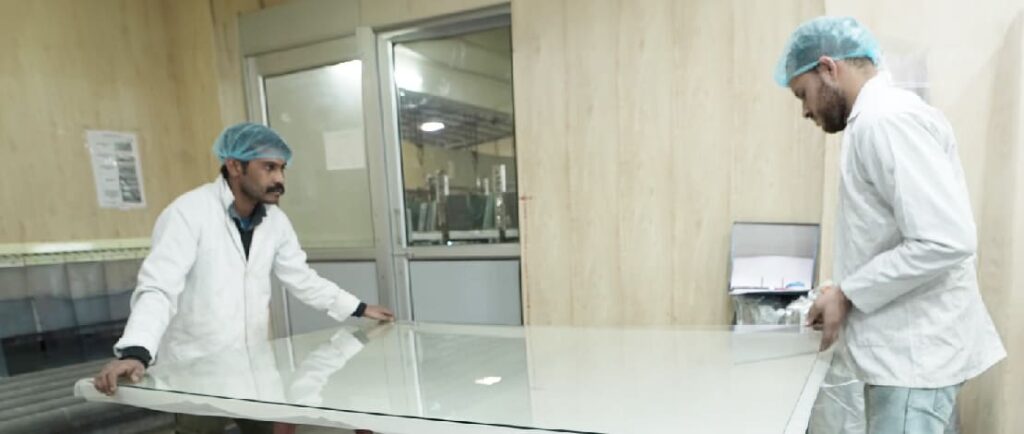
During this stage, a translucent plastic film (such as PVB, SGP, or TPU) is sandwiched between two glass layers. This layer is primarily used as a bonding agent between the two glass panes and can have additional benefits like defogging capabilities, embedded LED displays or UV rays absorption abilities.
- PVB: For high impact resistance (e.g., windshields).
- SGP: For high load-bearing capacity (e.g., safety windows).
- TPU: For high-security applications (e.g., armored glass).
- Fabric sheets: For creative elements (e.g. partition glass).
We have 3 moisture and dust control rooms where the application of these films is done with utmost care adhering to the process parameters.
Vacuuming & Pressing
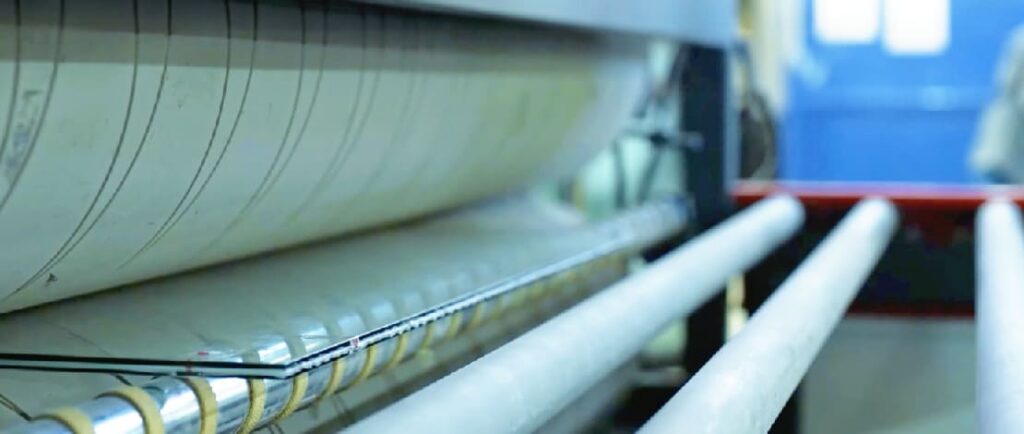
After layup the combination of glass passed through pressurized rollers in a pressing furnace in case of flat glass and heating ovens with vacuum rings applied on all four sides of glass in case of bend glass.
This pre-nip, de-airing process removes air trapped between the glass and the interlayers) as well as softening the PVB to give initial adhesion or pre-tacking.
We have 2 heating ovens (2440 x 3660 mm) and a pressing line (2600 x 5000mm) which can process glass of thickness 4.76 – 100mm
Autoclave
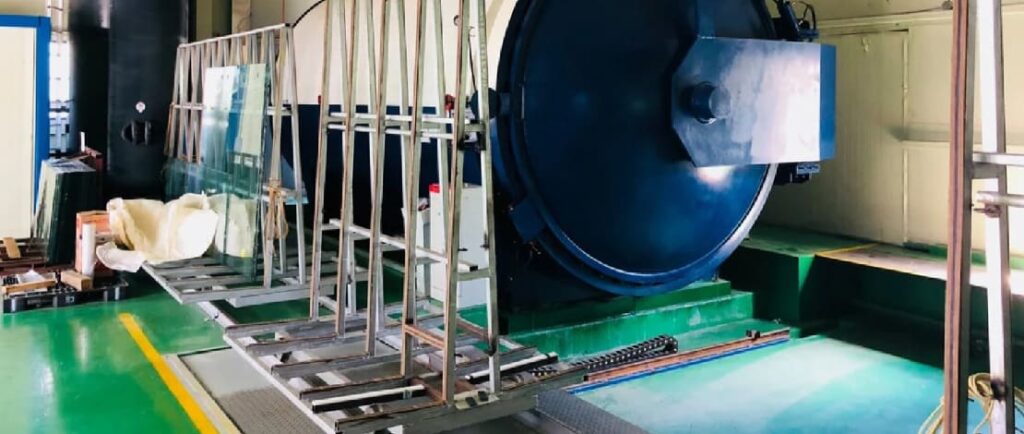
The final state in glass lamination is autoclaving where during a 6 hour cycle the glass is again heated and subjected to extreme pressure (between 8 and 12 BAR) permanently bonding the glass and the interlayer. It is during this final process that the glass becomes completely transparent.
Our fully automatic autoclave can process glass up to 3000 x 6000 mm in size and produce around 250 square meters of glass in every cycle.
Insulating
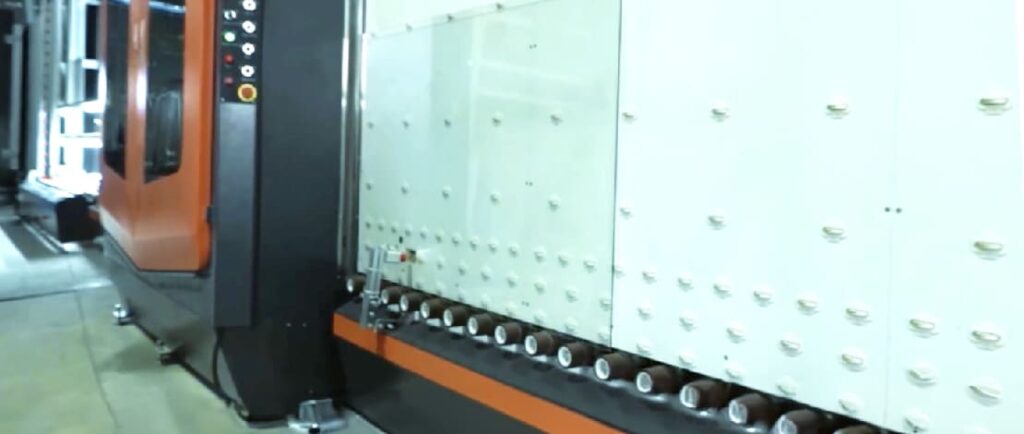
An insulated glass is made with a combination of glass separated by an aluminium spacer and filled with argon gas to provide heat and sound insulation capabilities. Functional and aesthetic enhancements, such as motorized blinds and Georgian bars, can also be integrated.
Spacer Assembly
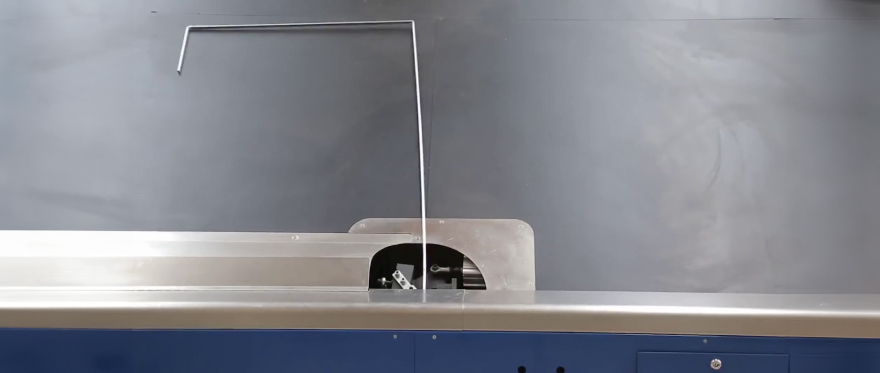
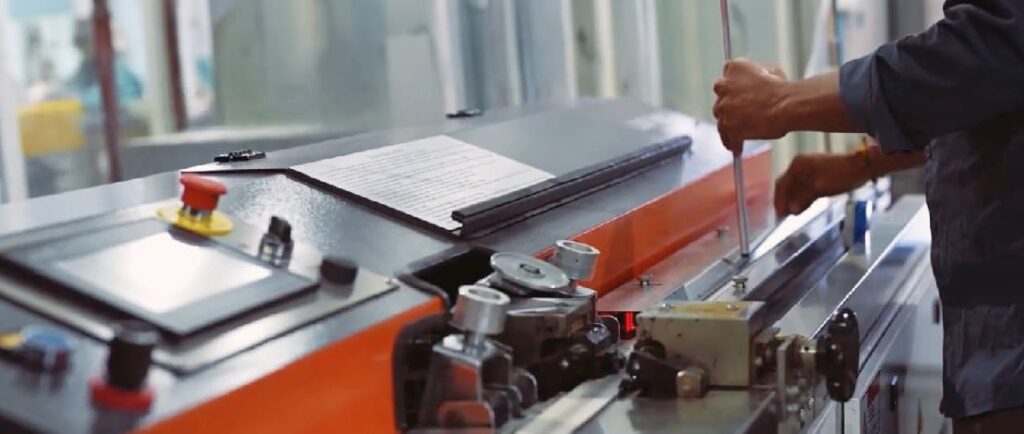
First the aluminum spacer is cut and bent with the help of a spacer bender to match the size and profile of the glass, ensuring a perfect fit. The spacer is then filled with desiccant, which absorbs moisture to prevent condensation inside the insulated glass. A primary sealant, butyl, is applied on both sides of the aluminum spacer. This ensures strong adhesion between the spacer and the glass layers, forming an airtight bond.
Insulated Glass Assembly
At our automatic insulated glass line we can process double, triple and 4 STEP glass of size 2600 x 3660mm up to the thickness of 90mm. Here glass layers, along with the aluminum spacer, are carefully assembled and pressed together to form a compact then a secondary silicone sealant is applied along the edges, packing the glass unit for durability and weather resistance. Finally, argon gas is filled between the glass layers, providing excellent thermal and sound insulation properties.